In-app advertising in 2026: a complete guide for mobile marketers
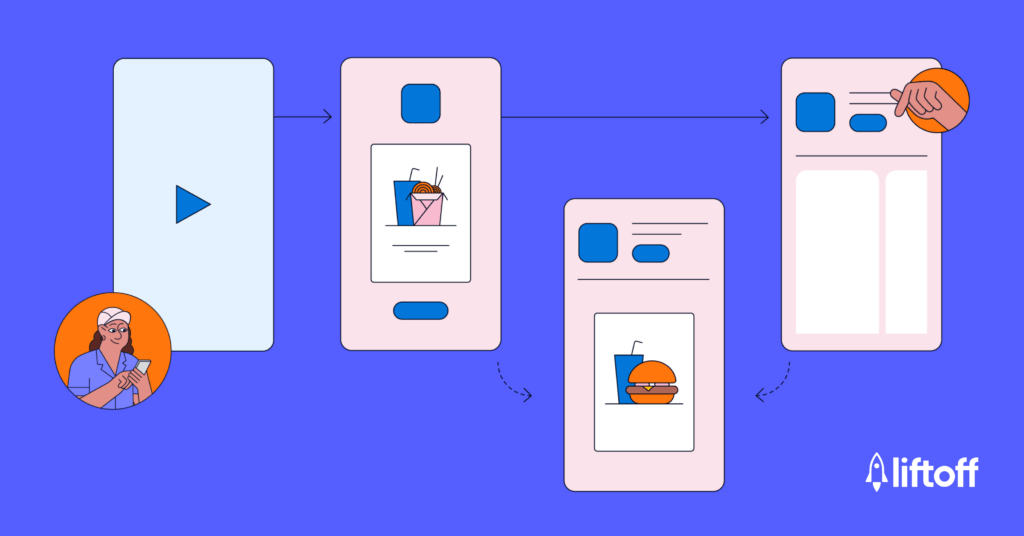
In-app advertising is the practice of displaying paid advertisements within mobile applications so publishers can monetize their content and advertisers can access mobile users in high-attention app environments. According to the IAB/PwC Internet Advertising Revenue Report: Full Year 2025, US digital advertising revenue reached $294.6 billion in 2025, a 13.9% year-over-year increase and the highest level in the report’s 30-year history, with mobile environments capturing an outsized share.
For mobile marketers, in-app advertising is a vital channel for reaching modern audiences. It’s where targeting and measurement are most sophisticated, and where the gap between average and top-performing campaigns is widening fastest. At Liftoff, we help mobile marketers make smarter decisions every day about which ad formats to choose, what eCPMs to expect, how in-app compares to mobile web, and how to build a mobile growth strategy.
What is in-app advertising?
In-app advertising refers to paid promotional content displayed inside mobile applications on smartphones and tablets. As Statista defines it, in-app advertising includes banner ads, interstitial ads, video ads, and native ads integrated into a mobile app’s interface. It is distinct from mobile web advertising, which is delivered through mobile browsers. That distinction matters more every year as consumers spend more and more time inside apps.
How does in-app advertising work?
In-app advertising operates through a connected ecosystem of four primary participants:
- Advertisers identify target audiences, build creative, set bidding strategies, and manage campaigns to reach mobile users inside specific apps.
- App publishers own the applications where ads are served and control which inventory to make available, when to surface ads, and how to balance monetization against user experience.
- Supply-side platforms (SSPs) aggregate publisher inventory and offer it to advertisers programmatically.
- Demand-side platforms (DSPs) allow advertisers to bid for and purchase that inventory across multiple networks and exchanges in real time.
A live in-app ad placement unfolds in milliseconds:
- The advertiser launches a campaign through a DSP.
- A user opens an app, and the publisher’s SDK surfaces an ad opportunity to its SSP.
- A real-time auction runs through an exchange using the OpenRTB protocol.
- The winning ad renders inside the app.
- Engagement is measured by the app’s mobile measurement partner (MMP) according to the standards in the IAB Mobile Application Advertising Measurement Guidelines, developed jointly by the IAB, the Mobile Marketing Association, and the Media Rating Council.
Targeting relies on contextual signals (e.g. app category, content, language), device signals (e.g. operating system, locale), and where consented, behavioral signals. On iOS, Apple’s App Tracking Transparency framework has reshaped what is possible at the user level, and the measurement layer has rebuilt around aggregated, privacy-preserving attribution standards like SKAdNetwork and AdAttributionKit.
Why in-app advertising is the dominant mobile channel in 2026
In-app advertising is the foundation of mobile marketing, and it’s being driven by two important shifts.
- A shift in consumer behaviour
Sensor Tower’s 2026 State of Mobile report found that consumers spent 5.3 trillion hours across iOS and Google Play apps in 2025, equivalent to roughly 3.6 hours per day per mobile user, with downloads reaching nearly 150 billion. The same report shows global in-app purchase revenue grew 10.6% year over year to $167 billion in 2025, with the United States remaining the largest mobile market at nearly $60 billion.
- A shift in ad budgets
The IAB/PwC Internet Advertising Revenue Report: Full Year 2025 found US digital advertising revenue reached $294.6 billion in 2025, a 13.9% year-over-year increase and the highest level in the report’s 30-year history. As budgets consolidate around performance-driven channels, mobile in-app environments capture an outsized share. AppsFlyer’s 2025 app marketing trends analysis reports that global app marketing spend reached $109 billion in 2025.
Our view at Liftoff is that this concentration of spend is structural, not cyclical: the audience is in-app, the measurement is in-app, and the most efficient performance signals are in-app.
Types of in-app advertising
There is no single best in-app ad format. Each serves a different objective and fits a different app context. The most common formats are summarized below, with eCPM figures from the Business of Apps Mobile Advertising Rates 2025 guide.
| Ad format | Description | Best for | 2024 eCPM (USD) |
| Banner ad | Rectangular graphic anchored at top or bottom of screen | Sustained presence in content apps | ~$2.80 |
| Native ad | Designed to match the host app’s look and feel | Content, social, and discovery apps | ~$3.30 |
| Interstitial ad | Full-screen ad at natural transitions | High-impact moments, app installs | ~$4.80 |
| In-stream video ad | Short pre, mid, or post-roll video clip | Video and entertainment apps | ~$6.50 |
| Playable ad | Interactive demo of an app or game | App install campaigns, especially games | ~$9.00 (2023) |
| Rewarded video ad | User opts in to watch in exchange for a reward | Gaming and utility apps | ~$10.50 |
Rich media is a creative capability rather than a separate inventory category. It refers to ads that incorporate interactive elements such as expandable creative, embedded video, audio, animation, or touch and tilt response, and these elements can be layered onto banner, interstitial, native, or video placements. Examples include an interstitial that expands to a full interactive experience when tapped, a banner with an embedded video player, or a native ad that responds to a swipe gesture. Playable ads are the most familiar form of rich media in mobile, since they are essentially interactive demo experiences delivered through standard interstitial slots.
A few practical notes from working with mobile marketers:
- Banner ads coexist with content rather than interrupt it
- Interstitial ads trade friction for full attention and benefit most from natural-break placement
- Rewarded video ads consistently lead on engagement and eCPM because users opt in, and the format is expanding from gaming into utility, education, and entertainment apps
- Playable ads are increasingly the format of choice for app install campaigns
- Native ads suit social feeds and content discovery apps
In-app video ads benefit from the broader video trend across mobile, and mobile app video ads (rewarded and in-stream) are the highest-yielding video subcategory by eCPM. More broadly, in app ads of any format are encountered by mobile users far more often than mobile web ads during a typical daily session.
In-app advertising platforms and the programmatic ecosystem
In-app advertising platforms span the demand side (where advertisers buy) and the supply side (where publishers sell). On the demand side, DSPs aggregate access to multiple networks and exchanges, providing campaign management, bidding, and creative tools. On the supply side, SSPs aggregate publisher inventory and route it through real-time bidding. Most publishers also use a mediation layer that sits between their app and multiple SSPs and ad networks, deciding which demand source gets each impression based on bid value and waterfall or in-app bidding logic.
The major platforms (Google, Meta, Apple, TikTok) function as both DSP and SSP within their walled gardens, with their own creative formats, attribution methodologies, and reporting layers. Outside the walled gardens, the open in-app ecosystem operates through OpenRTB and a connected network of DSPs, SSPs ( exchanges). For most mobile marketers, an effective strategy uses both: the major operators for the audience reach they control, and the open ecosystem for performance-driven user acquisition where transparency and incrementality matter more.
In-app advertising pricing models
In-app advertising offers several pricing models that align spend with the outcome an advertiser cares about.
| Pricing model | Pays for | Best for |
| CPM (cost per thousand impressions) | Every 1,000 impressions delivered | Awareness and reach |
| CPC (cost per click) | Each click on the ad | Click intent as a meaningful signal |
| CPI (cost per install) | A successful app install | User acquisition |
| CPA (cost per action) | A specified user action | Performance and conversion goals |
| ROAS (return on ad spend) | A target return based on revenue generated by acquired users | Performance UA campaigns focused on revenue and LTV |
The strongest user acquisition programs don’t optimize a single pricing model in isolation. They buy inventory on a CPI or CPM basis and optimize against post-install events that predict long-term value: registration, first purchase, Day 7 retention, return on ad spend, etc.
In-app advertising revenue and benchmarks
In-app advertising revenues are highly variable. They depend on ad format, geography, vertical, operating system, and audience quality. The following resources are useful benchmarks for setting expectations:
Format-level eCPMs. The Business of Apps Mobile Advertising Rates 2025 guide reports 2024 eCPMs of approximately $2.80 for banner ads, $3.30 for native ads, $4.80 for interstitial ads, $6.50 for in-stream video ads, and $10.50 for rewarded video ads. Rewarded video remains the highest-yielding format because of user opt-in.
Geography. The same analysis showed regional eCPMs of approximately $6.50 in North America, $5.00 in Europe, and $4.50 in Asia-Pacific (2024). North America consistently produces the highest in-app advertising revenue per impression.
In-app advertising revenue growth by vertical. AppsFlyer’s 2024 State of App Monetization report found in-app advertising revenue grew 26% year over year in non-gaming apps and 7% in gaming apps in 2024. Hybrid monetization, combining in-app advertising with in-app purchases, is the structural driver. Sensor Tower’s State of Mobile Gaming 2025 report similarly reported that games using hybrid monetization saw 37% growth in in-app purchase revenue year over year, well above the broader gaming average.
Hybrid model returns. For Android midcore games, the AppsFlyer monetization analysis found hybrid monetization generated a 146% return on ad spend by Day 90, compared with 93% for in-app purchase-only models and 58% for in-app advertising-only models. The highest-revenue apps no longer pick between in-app advertising and in-app purchases; they build for both.
In-app vs mobile web engagement. The Business of Apps in-app advertising guide reports in-app ads have a click-through rate of approximately 0.56%, roughly double the mobile web CTR of 0.23%. In-app environments also offer materially better protection against ad blockers and ad fraud.
In-app advertising vs mobile web advertising
The distinction between in-app advertising and mobile web advertising is one of the most consequential and under-considered strategic decisions in mobile marketing. The two share a device but very little else.
| Dimension | In-app advertising | Mobile web advertising |
| Where users spend time | The clear majority of mobile time | A minority of mobile time |
| Ad blockers | Largely unaffected | Widely blocked |
| Engagement (CTR) | ~0.56% (Business of Apps) | ~0.23% (Business of Apps) |
| Targeting signals | Device, app context, in-app behavior, MMP attribution | Cookies (deprecating), page context, browser session |
| Ad fraud exposure | Lower with verified SDK measurement | Higher exposure to MFA sites and bot traffic |
| Ad format range | Banner, interstitial, native, video, rewarded, playable | Banner, display, video |
| Measurement framework | MMP attribution, SKAdNetwork, AdAttributionKit (iOS) | Pixel-based, limited by cookie deprecation |
For most performance-driven mobile programs, in-app should be the foundation, with mobile web filling specific use cases rather than the other way around.
Vertical examples: how in-app advertising plays out across the top three categories
Three verticals account for most of the in-app ad inventory and spend, and each has its own performance shape.
Gaming
Gaming carries the lion’s share of in-app advertising activity. Sensor Tower’s 2026 State of Mobile report shows mobile gaming generated approximately $82 billion in in-app purchase revenue in 2025, with the genre shifting from scale toward lifetime value expansion. Within gaming, rewarded video and playable formats dominate because they align user incentives with advertiser goals. Casual and hypercasual genres rely on in-app advertising as a primary monetization model, while midcore and strategy games typically combine in-app advertising with in-app purchases. Our view is that hybrid monetization is now the default operating model in gaming, not the advanced option.
Shopping and e-commerce
Shopping is one of the fastest-growing in-app advertising verticals by spend. According to AppsFlyer’s 2026 trends analysis, shopping app user acquisition spend grew 66% year over year in 2025. In-app advertising in shopping favors native, video, and dynamic product formats. Retargeting performs especially well: as Business of Apps notes, approximately 65% of conversions in retail shopping apps come from retargeting efforts.
Finance and fintech
Finance is among the highest-CAGR verticals and the one where attribution accuracy matters most because of high customer lifetime values. Sensor Tower’s 2026 report highlighted that credit and lending app downloads climbed 18% year over year in 2025, while AppsFlyer’s 2025 trends analysis showed finance category user acquisition spend rising 71% on iOS. Post-install event quality (registration, first deposit, first transaction) drives campaign optimization rather than the install itself.
In-app advertising best practices
Effective in-app advertising campaigns require disciplined execution across creative, targeting, and measurement. The practices we consistently see separating top performers from their competitors:
- Choose attribution types and windows aligned to your campaign objective and user behavior, and match them across partners. Comparing performance across DSPs, networks, or measurement partners only produces apples-to-apples results when click-through windows, view-through windows, and attribution logic are configured consistently across them.
- Treat creative testing as a core competency. AppsFlyer’s 2025 Performance Index found the number of creative variations produced by the average app grew 40% in 2024 to 839 per month. In a market where targeting signal is constrained by privacy, creative is the variable that can still meaningfully move performance.
- Measure incrementality, not just attribution. Attributed conversions tell you which channel got credit for a conversion; incrementality testing tells you which channel actually caused the conversion. The strongest UA programs run regular incrementality tests to validate that paid spend is delivering true lift over organic baseline.
- Run user acquisition and retargeting in parallel. Per AppsFlyer’s 2025 trends analysis, global app marketing spend in 2025 totaled $109 billion, with $78 billion going to UA and $31 billion to remarketing. The most effective programs treat these as complementary investments rather than competing ones.
- Design conversion value schemas for what is predictive. SKAN gives developers up to 64 conversion values to map to in-app events. Mapping your most predictive Day 0 to Day 2 actions first beats mapping the easiest events to instrument.
- Build a privacy-first measurement stack. Apple’s App Tracking Transparency framework has reshaped iOS measurement, with SKAdNetwork and AdAttributionKit now the foundation of aggregated iOS attribution. The strongest UA programs blend SKAN and AAK postbacks with ATT-consented deterministic data, MMP modeling, and incrementality testing rather than relying on any single signal.
- Let the DSP optimize across formats and placements. Modern DSPs are designed to allocate spend dynamically across formats, app contexts, and placements based on real-time performance signals. The fastest way to damage performance is to lock the algorithm into rigid format-by-publisher rules.
The bottom line
Apps are the foundation to modern mobile marketing. They are where users spend their time, where engagement is highest, where targeting is most developed, and where the privacy-preserving measurement frameworks of the next decade were designed.
The gap between average and top-performing in-app advertising programs is real and growing, decided by creative discipline, monetization model design, and measurement maturity. The mobile marketers who build for that reality now will compound their advantage through the rest of the decade.
Frequently asked questions
What is in-app advertising?
In-app advertising is the practice of displaying paid ads inside mobile applications, allowing publishers to monetize their inventory and giving advertisers access to engaged mobile audiences. It includes banner, interstitial, video, native, and rewarded formats displayed within a mobile app’s user interface.
How does in-app advertising work?
Advertisers bid for ad impressions in real time through DSPs, the winning bid is rendered inside an app, and performance is measured by a mobile measurement partner such as AppsFlyer or Singular.
What are the types of in-app ads?
The main types are banner ads, interstitial ads, video ads (including in-stream and rewarded video), playable ads, and native ads. Rich media is incorporated into many of these format types to increase conversion rates.
What are in-app advertising examples?
Examples include a banner at the bottom of a news app, a full-screen interstitial between mobile game levels, a rewarded video that gives a user in-game currency for watching, a playable demo of a casual game inside another casual game, and a native ad in a social media feed matching surrounding content.
How much revenue does in-app advertising generate?
Global in-app advertising is one of the largest categories within digital ad spending, alongside search and social. According to Statista’s Advertising Market Outlook, the average ad spending per mobile internet user in the in-app advertising market is expected to reach $57.61 in 2026. For broader context, the IAB/PwC Internet Advertising Revenue Report: Full Year 2025 reports US digital advertising revenue reached $294.6 billion in 2025, the highest level in the report’s 30-year history.
How much can an app make from ads?
Revenue depends on monthly active users, ad format mix, geography, and audience quality. Business of Apps reported 2024 eCPMs of approximately $2.80 for banners, $4.80 for interstitials, $6.50 for in-stream video, and $10.50 for rewarded video. North American audiences generate the highest rates.
How to monetize an app with ads?
Design ad placements around natural user flow, prioritize formats aligned with the app’s content (banners for content apps, rewarded video for games and utilities, native for social and discovery), and consider hybrid monetization. AppsFlyer’s data shows hybrid models generated 146% return on ad spend by Day 90 for Android midcore games.
What is the average eCPM for in-app ads?
Business of Apps reports projected 2024 eCPMs of approximately $2.80 for banners, $3.30 for native, $4.80 for interstitials, $6.50 for in-stream video, $9.00 for playable rich media (2023), and $10.50 for rewarded video. Regional eCPMs run ~$6.50 in North America, $5.00 in Europe, and $4.50 in Asia-Pacific.
Which in-app advertising format performs best?
Rewarded video consistently delivers the highest engagement and eCPM because the user opts in. Playable ads also perform strongly for app install campaigns. The best format depends on objective: rewarded video and playables for user acquisition, native for content apps, interstitials for high-impact moments.
How does in-app advertising compare to mobile web advertising?
Business of Apps reports an in-app CTR of approximately 0.56% versus 0.23% for mobile web. In-app environments also offer more granular targeting, lower ad fraud exposure, and are largely unaffected by ad blockers.
What are the current in-app advertising trends?
Current in-app advertising trends include the shift toward video-led creative, the rise of hybrid monetization, the maturation of privacy-preserving measurement frameworks (SKAdNetwork and AdAttributionKit), and the application of AI to creative production and campaign optimization.
What is the future of in-app advertising?
The future is defined by three durable shifts: video and interactive formats taking share from static formats, hybrid monetization replacing single-stream models, and privacy-preserving measurement becoming the default. At Liftoff, we expect in-app advertising to continue absorbing share of digital ad spend through 2026 and beyond.